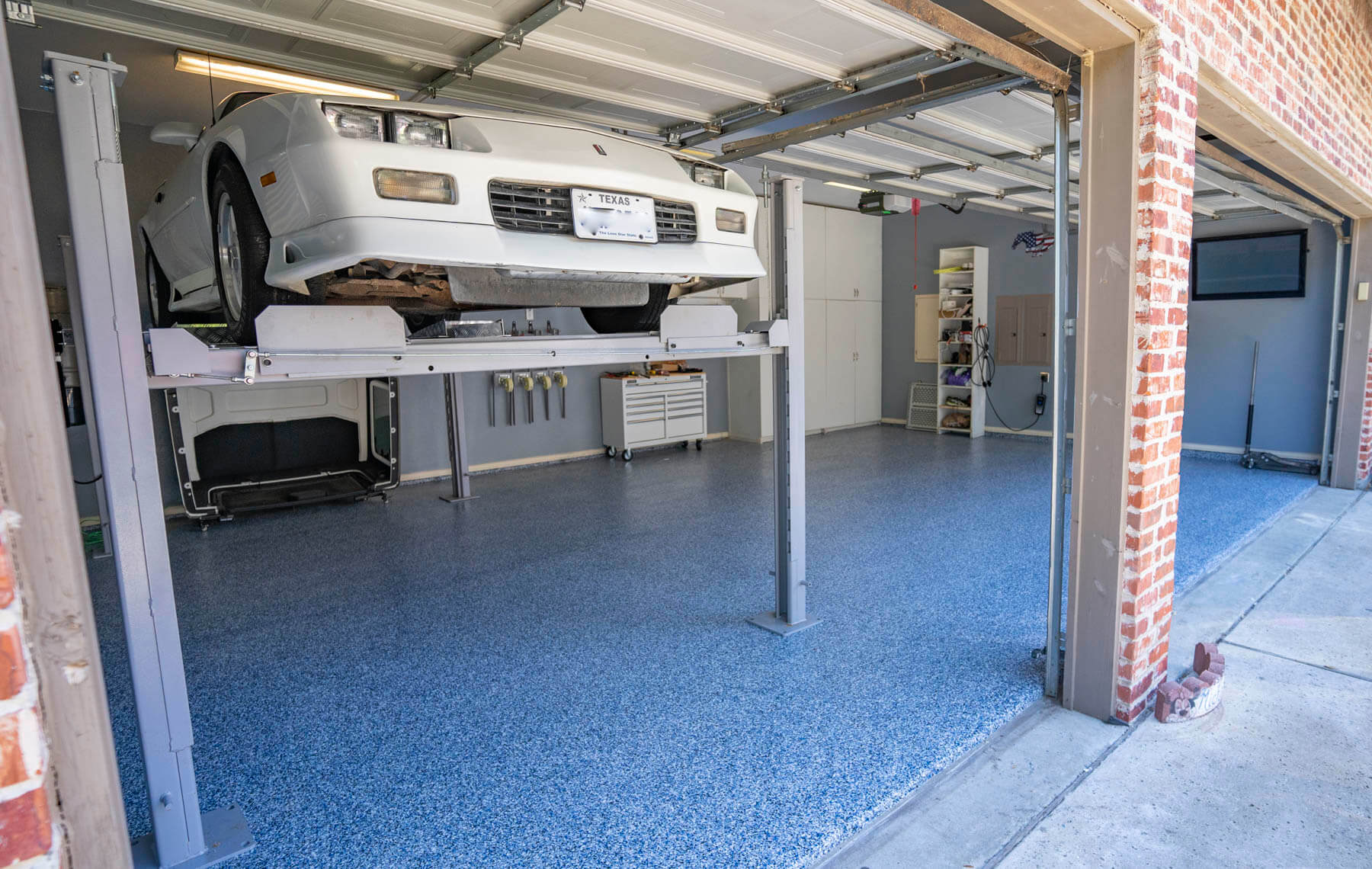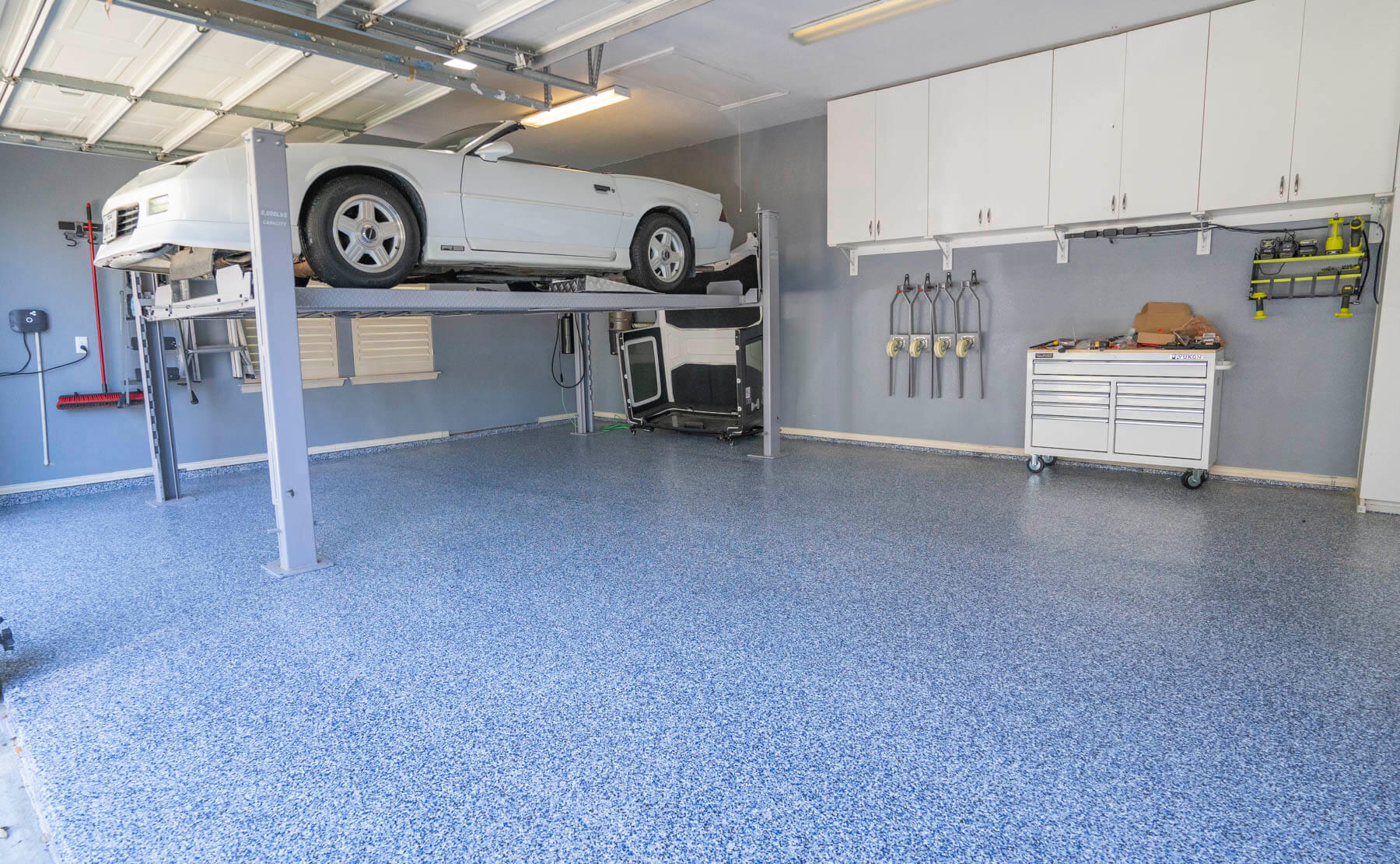
A two post lift puts the entire weight of a car onto four anchor bolts in your slab. Whether that is fine or terrifying comes down to concrete you cannot see. Work this out before the lift arrives, not after.
We are the floor people, not lift dealers. This is the floor half of the job.
Thickness and strength are two separate questions
Every lift manufacturer publishes a minimum slab specification, and it is a pair of numbers, not one. A depth of concrete, and a compressive strength for that concrete. A thick slab of weak concrete fails the spec just as surely as a thin slab of good concrete.
Find the spec for the exact model you are buying and treat it as the requirement. Do not take a number from a forum, and do not take one from an article, including this one. Manufacturers differ and they are the ones who warranty the lift.
How to find out what you have
Drill a small test hole somewhere out of the way and measure the depth before you hit dirt. It is the only method that actually tells you, and the hole patches invisibly under a coating afterwards.
If the house came with plans, the garage slab depth may be on them. A typical residential garage slab in a Texas subdivision is thinner than most lift specs want, and it very often has post tension cables in it. If yours does, drilling anchors is not a job to improvise. A cut cable is a serious repair.
Age matters too. Concrete keeps gaining strength for a long time, but a new pour needs its full cure before anything is anchored into it.
Want the number for your garage?
Get an accurate price online in about a minute. No sales visit, no waiting on a callback.
If the slab is not thick enough
The standard fix is a pad. You cut out the area under each post, dig down, and pour a deeper, properly reinforced footing tied to the specification the lift asks for. That is a concrete job, done before any flooring work.
The order matters. Concrete first, coating second. A new pad needs to cure, and a coating installed over a pad that has not finished curing will fail at exactly the spot you care about.
Do you coat the floor before or after the lift?
Before, almost always.
Grinding a slab with a lift bolted to it means working around four posts and never getting properly into those corners. The floor ends up finished everywhere except the one area that is going to see oil.
Coat the empty floor, then set the lift on top and anchor through the coating. A coating is a thin, hard, bonded layer, and anchors go through it into the concrete the same way they go through bare concrete. Tell your installer the lift is coming so the base plate areas are finished flat rather than with a heavy texture.
If the lift is already in, it is still worth doing. It just means a compromise at the posts, and you should hear that from whoever quotes it rather than discover it on the day.
Why a coated floor matters more under a lift
The floor under a lift is the dirtiest floor in the house. Drain plugs, filters, coolant, brake fluid and gear oil all end up there. On bare concrete every one of those goes in and stays. A coated floor lets you wipe it.
There is a safety side to it as well. Oil on a smooth slab under a raised car is exactly where you do not want to lose your footing. A flake finish gives the surface texture, which is one of the reasons flake is standard rather than decorative. More on that in what flakes actually do and non slip flooring.
And a coated slab does not dust. Under a lift that matters, because concrete dust is what ends up on everything you have just taken apart.
Ceiling height, while you are measuring
Not a floor question, but it is the other thing people get wrong. Measure to the lowest obstruction, which is usually the garage door track or the opener, not the ceiling itself. Then check the manufacturer's required height for the model, and remember the car sits on top of the lift, not inside it.
There is more on setting a garage up to work in at garage car lifts for a home garage and building a garage workshop.
Common questions
Will anchoring a lift damage a coated floor? You will get a clean hole and some dust. The coating does not spider or lift, because it is bonded into the concrete rather than sitting on it. Drill on a slow speed and vacuum as you go.
Can a four post lift go on a thinner slab? A four post lift spreads the load over a larger footprint and many models are not anchored at all, which is why people with thinner slabs often end up there. Check the specification for the model rather than assuming.
Does a coating hold up under jack stands? Point loads are hard on any floor. Put a pad or a piece of ply under a stand and it is a non issue. Dropped tools are covered by our lifetime warranty.
If you are planning a lift and want the floor done first, you can price the garage online in about a minute, or call 469-990-9990 and talk it through.