A winter home in Florida spends a big part of the year with nobody in it. The garage gets closed up in spring, and it sits through the hottest, wettest months with the door down and the air still. When you come back in the fall, what you find depends a lot on the floor. This guide is about choosing and caring for a garage floor in a house you are not always in.
What a closed garage goes through in summer
Florida summers are hot and humid, with storms most afternoons. A garage with the door shut and no air conditioning traps that heat and that wet air for months. Nothing moves the air. Nobody sweeps. Whatever dust, pollen and grime was on the floor in April is still there in October, and it has had all summer in humid air to turn musty.
The slab adds its own moisture. Most Florida homes sit slab on grade, and many areas have a high water table, so bare concrete can wick water up from below. A concrete floor can also sweat. When warm, wet air meets a slab that is cooler than the air, water condenses on the surface. You come home to a floor that feels damp and smells like it. The wider picture is in mold and mildew in a Florida garage.
Why the floor matters more when you are away
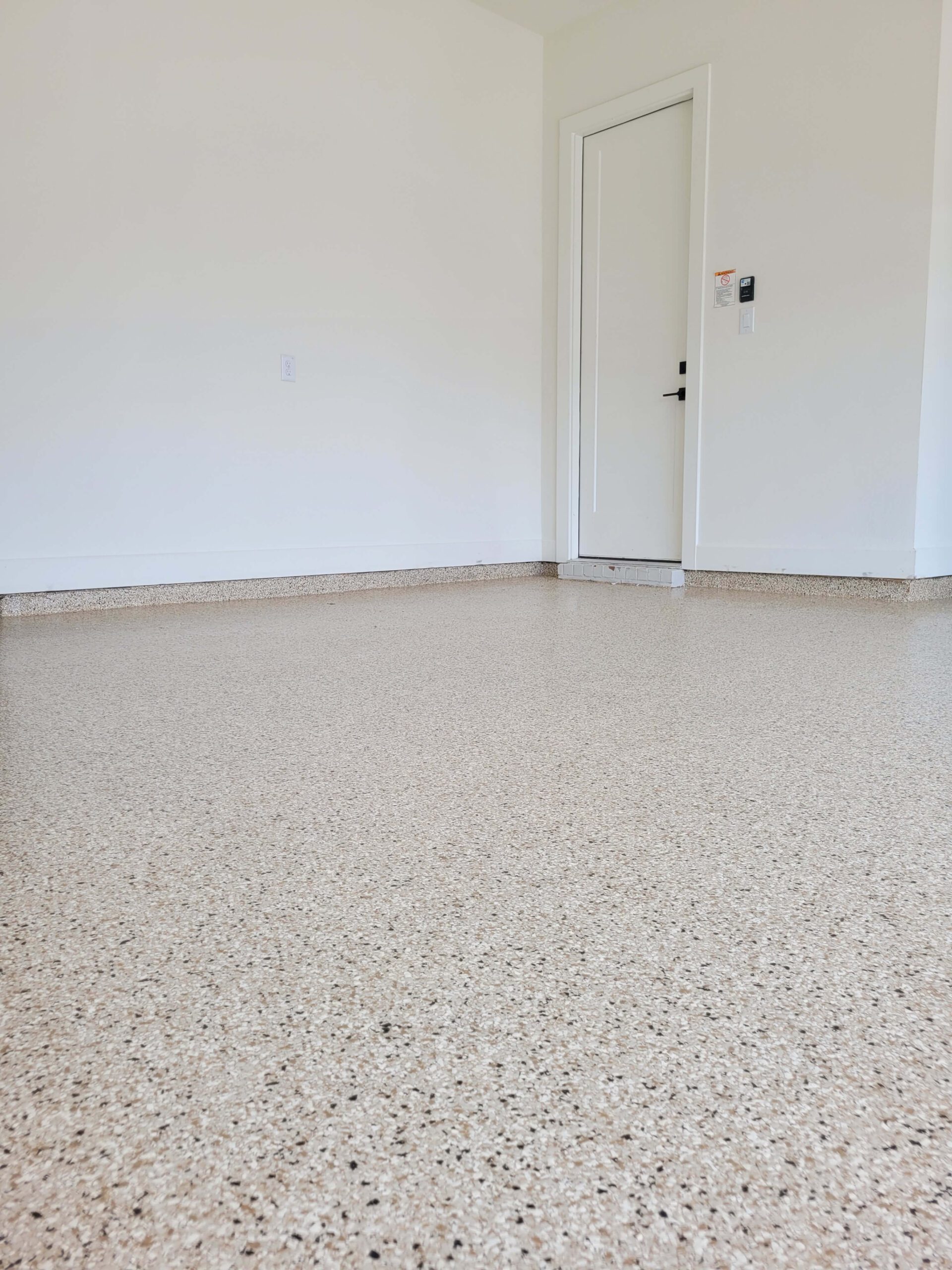
Bare concrete is porous. It holds moisture, it holds the organic grime that mildew feeds on, and it sheds a fine dust as it wears. Over a long, closed summer, all three get worse. A sealed flake floor works differently. Nothing soaks in. Grime sits on top, and a hose and a push broom take it off when you get back.
Be clear about what the floor does and does not do:
- It does stop the floor itself from holding water, oil and grime, and it ends concrete dust.
- It does make the return clean up a rinse instead of a scrub.
- It does not dry the air. A closed garage will still be humid.
- It does not stop condensation. Warm, wet air can still bead on a cool surface, coated or not.
- It does not protect boxes, tools or furniture stored in the garage from a musty summer.
If the air is the problem, treat the air. A dehumidifier helps, but one running unattended for months should drain through a hose to a drain or outside, not into a bucket that fills in a few days. Shelving that keeps stored things off the floor helps too.
Want the number for your garage?
Get an accurate price online in about a minute. No sales visit, no waiting on a callback.
Storing a car or golf cart for months
Many winter homes keep a car, a golf cart, or both, parked in the garage all summer. A vehicle that sits for months can leave a slow drip of oil or coolant that nobody sees. On bare concrete that drip soaks in and stays. On a sealed floor it sits on top, and polyaspartic resists oil and most household chemicals, so it wipes up when you get back. A drip tray under the engine is still a good idea.
Golf cart batteries need attention before you leave. Follow the maker's advice on charging or a battery maintainer. If a battery leaks, clean it up when you find it. Do not leave a leaking battery sitting on any floor, coated or bare, for a whole summer.
The drive down matters too. A car that just came off hours of hot highway pulls into the garage with hot tires. On a weak coating, hot tires can soften the surface and lift it. Polyaspartic resists that. The details are in Florida sun and hot tires.
If you are pricing garage floor coating in Venice for a home you drive to each winter, ask about hot tire pickup on any quote.
Hurricane season while you are gone
Hurricane season runs June 1 to November 30. For most seasonal owners, that is exactly the stretch the house sits empty. Before you leave, get stored things up off the floor, keep chemicals and fuel cans on shelves, and arrange for someone to check the house after a storm.
Be realistic about the floor. A coating does not waterproof a garage, and it does not stop water from coming in under the door. What it does is make the clean up easier if water does get in, since mud and debris sit on a sealed surface instead of soaking into bare concrete. A slab that sat under water still needs to dry before anyone works on it. The full guide is garage floors after a hurricane or flood.
Planning the install around your calendar
Seasonal owners have less time in the house, so the process should not eat it. There is no salesperson and no home visit. You see your exact price online in about a minute, which means you can price the floor from wherever you are spending the summer. Our own installers do the work, never subcontracted.
Plan the install for a stretch when you are in the house, so you can see the finished floor and walk on it. Clear the garage before the date. Coats are ready for the next quickly, so the garage comes back fast. If you are looking at garage floor coating in Sarasota, early in your season is a sensible time, before the house fills with guests.
One honest note on timing. If a slab is pushing real moisture, or is likely to keep moving, we tell you before we start. That can mean extra preparation or a new date. When your time in town is limited, it is better to know that up front than to find out halfway through. That holds anywhere in the state, including a home you might be pricing for garage floor coating in Bradenton.
A warranty tied to the owner
An interior residential garage floor carries a lifetime warranty for as long as you own the home. It covers peeling, blistering, fading and yellowing. For a winter home you plan to keep for years, that matters. The floor is covered while it is yours, whether you are in the house or not. The full terms are on the warranty page.
Many seasonal homes also have a lanai or a pool deck. Exterior residential surfaces carry a 10 year warranty. On outdoor installs, changes in appearance caused by sunlight, aging or natural wear are not covered. That is how any outdoor surface behaves in strong year round sun, and it is better said plainly. If you are looking at garage floor coating in Lakewood Ranch and the lanai needs work too, it makes sense to price both at once and weigh the two warranties side by side.
A simple routine for leaving and coming back
A sealed flake floor needs very little. The point is to leave it clean and dry, and to clean it once when you return.
- Before you leave: sweep out sand, rinse, and let the floor dry with the door open. Wipe up any spills. Lift stored things onto shelves. Set a drip tray under the car and look after the cart battery.
- While you are away: if someone checks the house, ask them to look at the garage floor after big storms.
- When you return: open the door and let the garage air out. Hose the floor and push broom it. Check under the car and the cart for drips.
That is the whole job. More detail is in how to maintain your garage floor coating.
For how the system is built around the state's climate, start with garage floor coating in Florida.